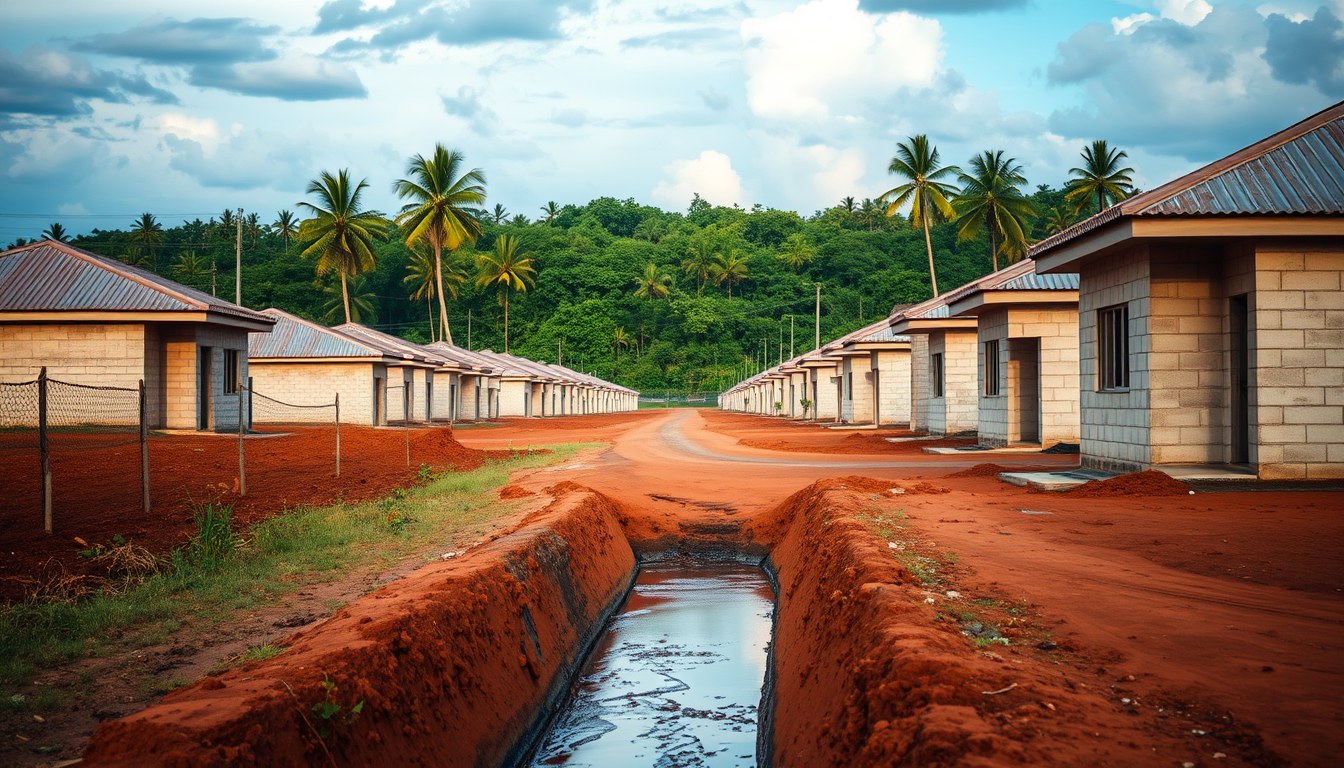
Suriname's housing debate usually starts in Paramaribo. The final results of the Ninth General Population and Housing Census, presented by the General Bureau of Statistics (ABS) on Friday 27 November, show that this is no longer where most new demand comes from. Of the 96,394 people Suriname added between the 2012 and 2024 censuses, the capital took about 16,500. Wanica took 60,100.
wimpel.online has already covered what the census says about ageing and the labour force (Suriname's 638,032 and a Demographic Window That Will Not Last). This article reads the same 318-page ABS report with a different question in mind: where do people live, in what kind of homes, and on whose land? The figures describe the situation at the census moment, midnight on 13-14 October 2024.
A growth ring around the capital
The census counts 638,032 inhabitants. According to the ABS, 435,800 of them live in Paramaribo and Wanica, slightly more than two-thirds of the total. That combined figure hides two very different trends. Paramaribo grew from 240,900 to 257,500 people, which the ABS calls an average of only 0.6 percent a year. Wanica grew from 118,200 to 178,300, or 3.4 percent a year.
The fastest growth was in the coastal districts around the capital. Commewijne grew by 3.6 percent a year to 48,200 residents, Para by 3.3 percent to 36,600, and Saramacca by 3.2 percent to 25,800. Nickerie also grew, by 2.1 percent a year. Sipaliwini (-6.0 percent a year) and Brokopondo (-4.5 percent) recorded far fewer residents than in 2012, while Marowijne (-0.6 percent) and Coronie (-0.1 percent) declined slightly.
Together, Wanica, Commewijne, Para and Saramacca gained about 97,000 people, slightly more than the net national increase. The ABS says this points to a trend of people settling in the districts around the capital. It adds that further research is needed to show whether people are leaving Paramaribo itself and whether the capital's built-up area is spreading outward.
171,700 households, and they are getting smaller
For housing demand, the number of households matters more than the number of people. The census counts 171,700 private households. Paramaribo has 70,200 and Wanica 47,500, followed by Commewijne (13,700), Nickerie (13,000), Para (9,500) and Saramacca (7,600).
The average household has 3.6 members, down from 3.8 in 2012 and 3.9 in 2004. Smaller households mean more homes are needed for the same number of people. As an illustration only, and not an ABS projection: at 3.6 people per household, Wanica's 60,100 extra residents would equal roughly 16,700 additional households.
One figure needs care. The census recorded only 5,000 one-person households, fewer than in earlier censuses. The ABS says this probably reflects how hard it was to reach people who live alone. Developers planning studios or small apartments should not read that number as a sign of weak demand.
Owners, renters and the state as landlord
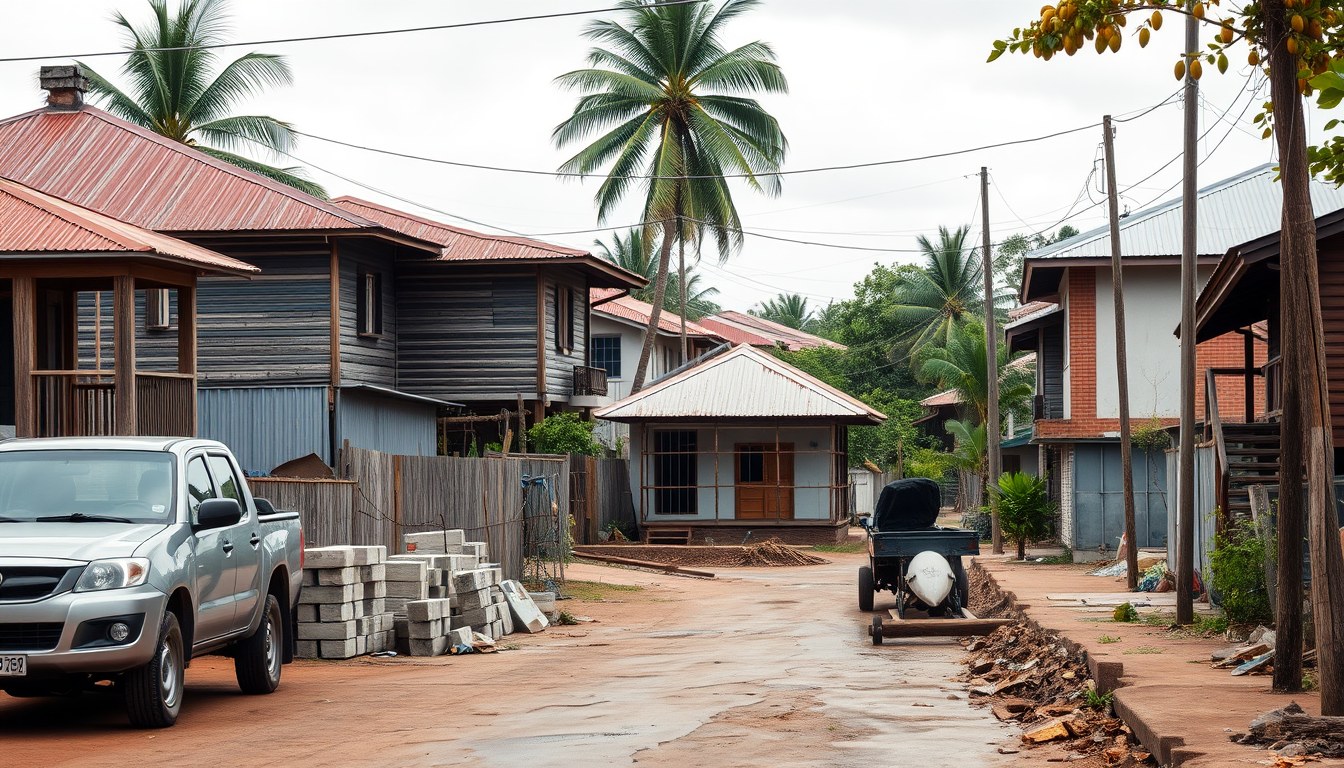
Suriname remains a country of owner-occupiers. Of 171,751 households in the tenure tables, 103,586 (about 60 percent) live in a home owned by a household member. Another 29,820 (about 17 percent) live in a home owned by family or an estate. Only 21,892 households, about 13 percent, rent from a private owner or a company.
That private rental market is concentrated in the capital. Paramaribo has 12,222 privately renting households, more than half of the national total and about 17 percent of the city's households. In Wanica the share is about 11 percent.
Wanica leads in a different category: state-linked housing. It has 3,214 of the 7,731 households that rent from the government, and 1,231 of the 2,700 households in hire-purchase arrangements. In both cases that is more than four in ten nationally, which suggests public housing has followed the same move to the outskirts as private buyers.
Whose land?
The census also asked on what basis each household uses the land under its home. About half (84,614 households) said the land belongs to a household member, and 30,903 said it belongs to family or an estate. Another 26,294 households, about 15 percent, live on state land (overheidsgrond).
That share varies widely by district. It is about 6 percent in Paramaribo but about 21 percent in Wanica, about 31 percent in Saramacca and about 38 percent in Commewijne. Wanica and Commewijne together account for close to six in ten households nationally that live on state land.
The fastest-growing districts are therefore also the ones where the state's land administration matters most for property finance. The census figures do not say under what title the land is held, for example land lease or other state-issued rights, so they cannot show how many of these plots banks would accept as collateral. Only 330 households said they use land without permission.
An ageing housing stock that needs repair
The census shows both recent construction and a large repair backlog. Households reported that 66,311 occupied dwellings, about 39 percent of the stock, were built between 2015 and 2024. Annual figures ranged from 5,115 for 2024 to a peak of 8,783 in 2020, with 5,776 reported for 2023. The 2024 figure probably covers only part of that year, because the census refers to the situation on 14 October 2024. These are construction years as residents reported them, not building-permit records.
At the same time, 61,235 households (about 36 percent) said their home needs major repair, and another 3,248 said it is beyond repair. Stand-alone dwellings (zelfstandige woonverblijven) make up 88.5 percent of the stock, and huts, barracks and other non-conventional units 3.1 percent. Building blocks are the main wall material in 57.5 percent of dwellings, and 98.2 percent have metal roofs. Three bedrooms is the most common layout, found in about 42 percent of households.
The market is therefore not only about new plots. Home-improvement lenders and contractors who renovate existing homes have a large addressable market in Paramaribo and Wanica, which together hold about 41,800 of the homes that need major repair.
Read the growth rate with caution
Feasibility studies need one caveat. The ABS added people missed by the count to the 2024 total, based on a post-enumeration survey that estimated 65,900 people in private households had not been counted, about 10.5 percent of the private-household population. The 2012 total was never corrected in the same way, even though that census's survey found a 4.15 percent undercount. The ABS itself says this overstates growth. On a like-for-like basis, the increase since 2012 falls from 17.8 to 13.1 percent, and annual growth from 1.4 to 1.0 percent.
The correction also differs by district. In its presentation, the ABS says the adjustment was largest in Para. No post-enumeration survey was held in Sipaliwini, where the undercount was estimated by comparison with Brokopondo. Growth figures for those districts are the least certain.
The direction of the story does not change. Demand has moved from the capital to its ring, households are getting smaller, and the state is a major landholder beneath that growth. The 350-home Reeberg project in Wanica (350 Homes at Reeberg, 30,000 Households in Need) shows how far individual projects are from meeting that demand. Investors now have district-level data, but should not extrapolate the headline growth rate.
Sources & further reading
- ABS: Resultaten Negende Volks- en Woningtelling Suriname, Census 2024 (November 2026)
- ABS: Census 2024 results presentation (English, November 2026)
- ABS: Censusstatistieken 2024 (report and presentations)
- Starnieuws: Census 9: Suriname telt 638.032 inwoners en vergrijst
- Starnieuws: Suriname heeft ruim 96.000 inwoners meer dan in 2012
- Starnieuws: Aandeel 65-plussers in Suriname meer dan verdubbeld
- City Population: Suriname districts, census 2004 and 2012
- Suriname's 638,032 and a Demographic Window That Will Not Last
- 350 Homes at Reeberg, 30,000 Households in Need