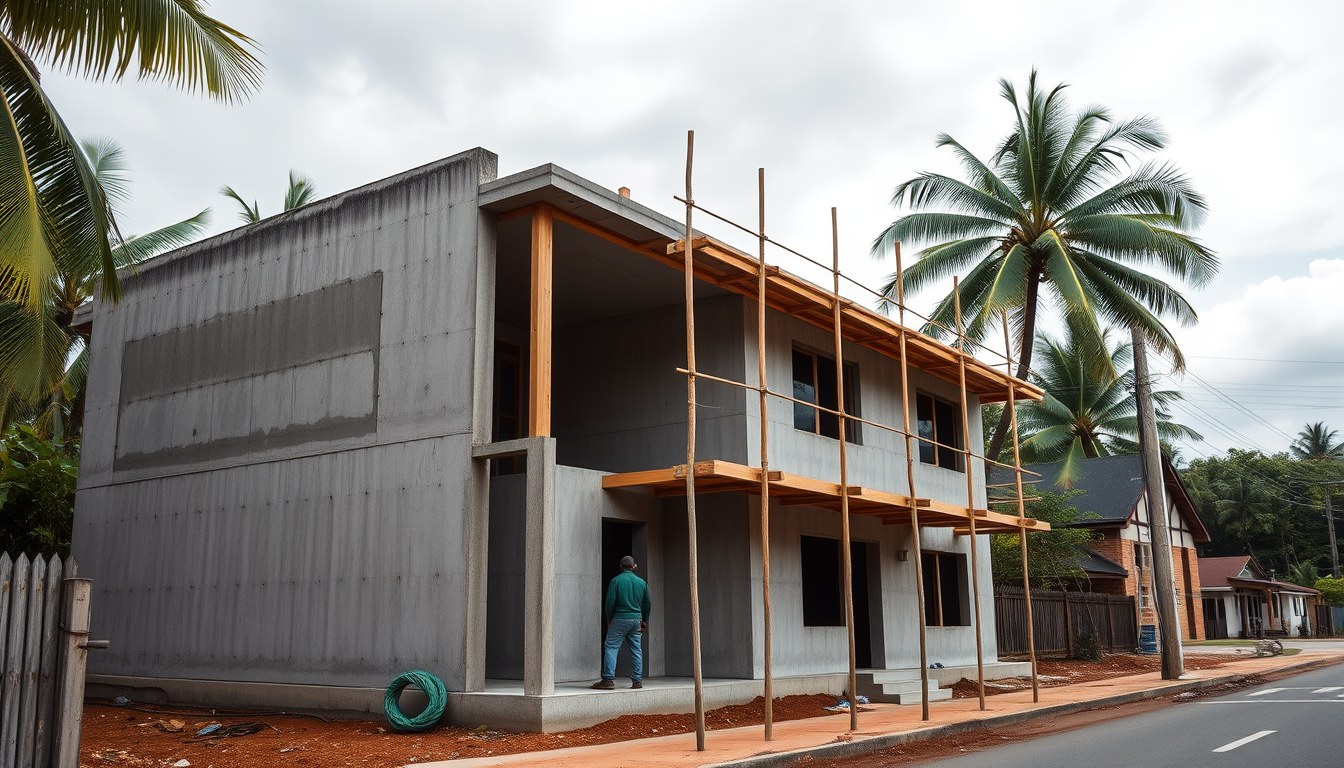
The cost of putting up a house in Suriname is climbing far more slowly than it was. The Algemeen Bureau voor de Statistiek (ABS) put its construction price index at 1,268.3 points in the third quarter of 2026, up 1.8% on the second quarter and 3.0% on a year earlier. Twelve months ago the annual rate was 15.2%. The figures are preliminary.
It is tempting to read this as relief for anyone trying to build. It is better read as a pause in a price level that was reset sharply higher, in an economy still waiting for oil money.
What the index shows
The annual rate has fallen in steps, according to the PAM N.V. summary of the ABS release: 15.2% in Q3 2025, 13.4% in Q4 2025, 7.2% in Q1 2026, 6.7% in Q2 2026 (revised down from a preliminary 7.3%) and now 3.0%. Dagblad De West, citing the ABS, gives the Q2 level as 1,245.7 and the Q3 level as 1,268.3. PAM stresses that 3.0% means prices are still rising, only more slowly than in 2025.
Part of the fall is arithmetic. Prices jumped so much in 2025 that the base for comparison is now high. PAM's October paper puts the 2025 full-year rise at 11.0%, and cites earlier annual moves of +63% in 2021, +47% in 2022, +50% in 2023 and -8% in 2024; PAM gives no source for those earlier figures. PAM lists the index at 1,249.0 in Q4 2025; against that, the Q3 2026 level of 1,268.3 is about 1.5% higher. Because the ABS revises its series, and the quarterly changes reported by De West (+0.1% in Q1 and +0.7% in Q2) do not line up neatly with every published level, the exact quarterly path should be treated with caution until the final figures appear.
Finishing trades up, structure down
Beneath the headline, the picture is uneven. De West's sub-index levels show carpentry rising from 1,452.6 to 1,541.7 (about +6.1%) and steel and concrete works falling from 1,466.9 to 1,426.9 (about -2.7%), which matches the changes PAM reports for those lines. De West also gives masonry and concrete pouring rising from 1,715.0 to 1,796.8, about +4.8%; PAM reports a +4.8% move for tiling, so readers should treat the labelling of that line with care until the ABS tables are checked. De West says its plumbing and electrical installation indices rose, without giving values, while PAM reports a 0.7% fall in sanitary facilities; these may be different lines, and the ABS tables would settle it.
The reading for developers is that structural steel and concrete costs eased while carpentry and other finishing work, which is more labour-intensive, kept rising. For a buyer of a completed home, the second matters more than the first.
What the index leaves out
Labour carries a weight of 41.73% in the index, but the ABS holds that share constant instead of collecting separate labour prices, De West notes. If wages are rising faster than materials, the real cost of building is understated. The index also tracks 107 items in 16 main groups at about 50 price points in Paramaribo and Wanica only, so it says little about the districts or the interior.
PAM's October paper adds a related caution. It records construction costs tracking the exchange rate because so much is imported, and notes sub-indices that ran far ahead of the headline in Q4 2025: carpentry +26.5% and electrical installation +31.7% year on year. A slower rise from those levels is still a rise from a higher floor.
Credit, mortgages and a missing rent number
Costs are only half the affordability equation. PAM reports that housing-construction credit was 17.3% of SRD bank credit in April 2026, a sector share rather than the mortgage portfolio, while total SRD credit grew 26.4% year on year. The cheap lines are narrow: a 7% facility, and a National Housing Programme fund of SRD 250 million at 3% and 5% interest. PAM states that the 7% facility has provided around SRD 200 million since the end of 2023, without citing a source for the figure.
Against that, PAM cites a housing shortage of about 30,000 households (a government figure attributed to the Ministry of Social Affairs, dated 9 July 2026, published without a method) and housing and utilities inflation of 7.6% year on year in August, which PAM calls only a rough measure of the housing market. What Suriname still lacks, PAM argues, is a rent index, a house price index or public transaction data. PAM says the IMF recommended a house price index to monitor real estate risks in May 2026, and plans the first edition of its own Vastgoedmonitor on 22 December 2026.
Why it matters before first oil
PAM notes that first oil from GranMorgu is expected in 2028, and, citing DiPasquale and Wheaton (1996), that building typically takes two to five years from decision to completion. A builder who starts on expectation may therefore finish after any demand surge has passed. A calmer cost index may give the sector some breathing room, but that is an inference, not something the data show. On 30 October, at a presentation of land documents to more than 900 beneficiaries in Wanica, Minister Melvin Bouva, speaking on behalf of President Jennifer Simons, said land allocation should be part of a broader housing policy. According to KeyNews, the government wants to tie plot allocation more closely to housing construction and actual land use, and to evaluate land conversions made between 2020 and 2025.
The test for policy is therefore not whether the construction index slows, but whether serviced land, affordable credit and measured prices arrive before the next cost shock. Until the next ABS index, due on 29 January 2027, the safe reading is modest: construction inflation has cooled, but the index gives no sign that homes in Paramaribo have become cheaper to build.
Sources & further reading
- PAM N.V., Marktpuls: bouwprijzen +3,0% op jaarbasis (4 November 2026)
- Dagblad De West, Bouwprijzen verder gestegen (3 November 2026)
- ABS Suriname, Bouwprijsindex releases
- PAM N.V., How the Surinamese real estate market works (October 2026)
- KeyNews, Government wants to curb land speculation
- Related: A Plot Is Not a House: Suriname's Land-to-Home Gap
- Related: NaHuSur: Can a Housing Fund Outlast Politics?