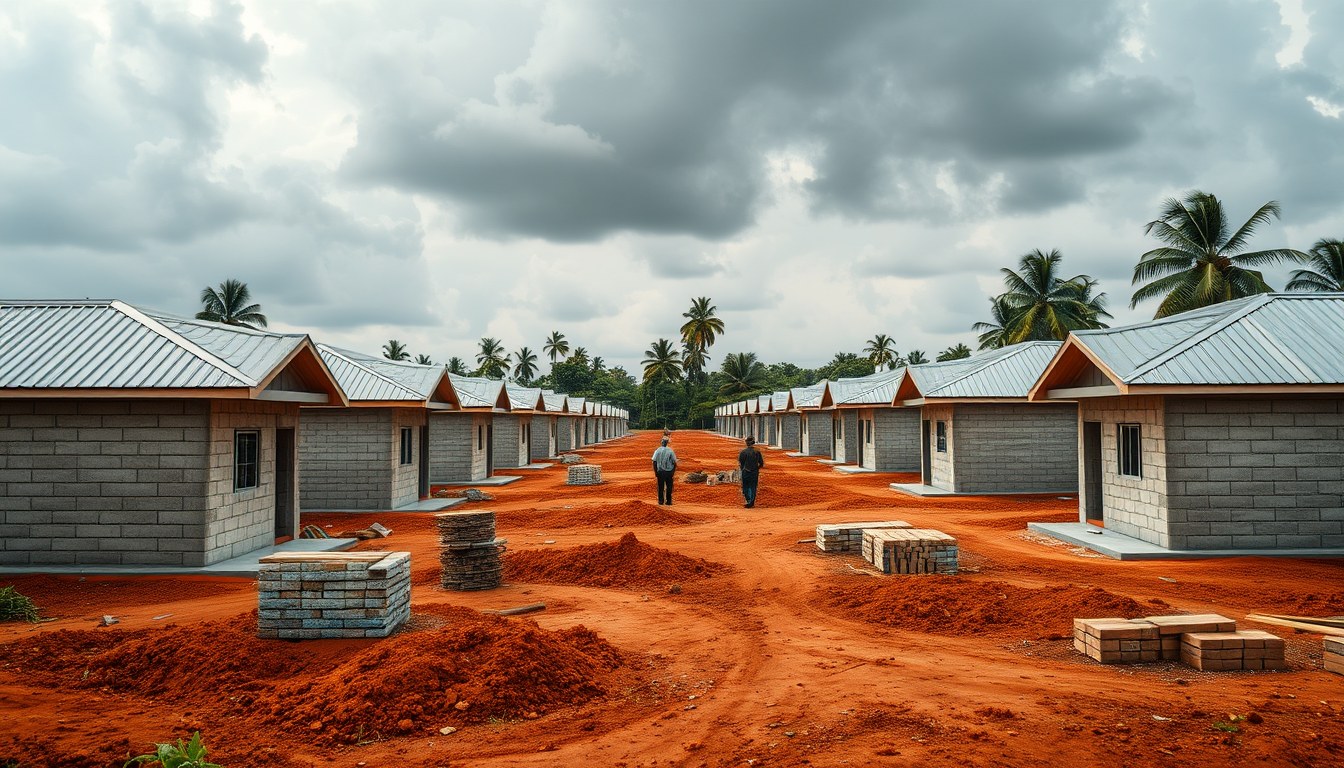
On Wednesday 8 July 2026, President Jennifer Simons and Vice President Gregory Rusland laid a first stone at the Reeberg project in Wanica and formally launched the National Housing Programme Suriname (NaHuSur). The ceremony finally puts to work the National Housing Fund Act of 2019, a law Simons was involved with at the time as chair of the National Assembly. The government has provisionally deposited SRD 250 million in the fund to finance its first loans, according to Key News and state broadcaster STVS.
The political message was blunt: housing should no longer depend on which party holds power. The fund, Rusland stressed, must work through banks so that allocation stays outside party politics. Simons told the audience she wants "a fundamental program that will still exist after 15 to 20 years", as reported by Times of Suriname. Whether the design can deliver that is a question of mechanics, not rhetoric.
Two tracks, three rates
NaHuSur runs on two financing tracks, as set out by De Snelle Pen:
- The National Housing Fund: rates of 0, 3 or 5 percent depending on which of three income groups the borrower falls into, with a maximum term of 25 years, for buying, building, renovating or extending a first home.
- The 7 percent bank mortgage: issued through financial institutions with a maximum term of 30 years, which can also finance the purchase of a building plot. Reports differ on the maximum loan amount, so applicants should confirm the current ceiling with their bank.
Both tracks require a minimum net income of about SRD 12,000, and repayments may absorb at most 30 to 50 percent of income. Fund applicants must be adult Surinamese nationals who own no other real estate, fund director Ramjielal said, according to Key News and STVS. The required documents include a statement of no real estate from the land registry agency MI-GLIS. The route runs from online registration at nahusur.gov.sr through pre-screening, financial assessment, intake, possible plot allocation and credit approval to notarial settlement. The fund does not take applications at a counter: files arrive only via financial institutions, and applicants can check online that their file is registered and see their sequence number, according to Times of Suriname.
What it means for banks, builders and investors
For banks, the fund is a channel rather than a competitor: applications for its credit come in through them. For contractors, the model is market-led. The state does not hand out houses; private developers build, and buyers choose a home within their means and take a draft construction-purchase agreement to a bank. The stick is explicit: builders who fall short will be blacklisted and their homes will no longer be financed through the fund, Suriname Herald reported. The government also plans to set price and floor-area limits, which Simons expects to push the sector towards cheaper and more efficient construction, according to Times of Suriname and Key News.
For investors, the novelty is that private individuals and pension funds may put money into the fund, with tax-free returns, as both Key News and STVS reported. That matters: a fund that relies solely on budget transfers is exactly the kind of programme that stalls when governments change. Simons also pitched it as an alternative to holding savings in foreign currency, and argued that much of the building material is produced locally, so the spending should feed national output.
The arithmetic problem
Here ambition meets capacity. Minister of Social Affairs and Housing Diana Pokie put the need at about 30,000 people. Simons framed the benchmark as 10,000 homes in four years: "Belangrijk, als we 10.000 huizen in vier jaar bouwen, zijn we geweldig" (if we build 10,000 houses in four years, we are doing great), she said. Yet only about 600 people are expected to gain access to a mortgage or a home this year, roughly 300 through the fund and 300 through the Affordable Housing Project, according to Suriname Herald. Her own caveat, in the English rendering by Times of Suriname, was telling: "Even if the funds were to be available, the building capacity is not."
History supports her caution. After the 7 percent scheme was adjusted in November 2023, it had generated around SRD 200 million in credit by early 2025, financing 73 new builds, 52 new-home purchases, 20 plot purchases and 67 renovations or extensions, Key News reported. That is roughly 200 transactions in some 15 months. Reaching 10,000 homes in four years would require about 2,500 a year, more than ten times that pace. The Affordable Housing Project figures cited at the launch, 150 homes at Reeberg plus 150 at Voorburg and 55 at Pontbuiten that the ministry plans to start this year, show how modest the starting point is.
wimpel.online's take
NaHuSur's architecture is sounder than that of a typical one-off project: a statutory fund, bank-based applications, transparent queuing and a door open to pension capital. Land policy may help too: on 10 July in Nickerie, Simons announced plans to stop ground leases on built plots from lapsing after 40 years, according to the government of Suriname. But SRD 250 million and some 600 beneficiaries is a pilot, not yet a programme. The real tests are whether pension funds actually commit, whether price caps leave builders a margin, and whether contractor capacity scales. If those hold, NaHuSur could outlast its founders. If not, it risks joining the list of stalled schemes it was designed to end.
Sources & further reading
- Key News: NaHuSur moet woningbouw uit politieke sfeer halen (9 July 2026)
- STVS: Uitvoering Nationaal Huisvestingsprogramma markeert start duurzaam huisvestingsbeleid (9 July 2026)
- Suriname Herald: Simons: 10.000 woningen in vier jaar zou grote stap zijn voor Suriname (9 July 2026)
- De Snelle Pen: Overheid lanceert Nationaal Huisvestingsprogramma (8 July 2026)
- Times of Suriname: President Simons launches National Housing Program Suriname
- Times of Suriname: Woningbouwfonds moet economie stimuleren
- GFC Nieuws: Regering stort SRD 250 miljoen in Nationaal Woningbouwfonds
- Key News: Aanpassing 7%-financieringsfaciliteit stimuleert woningbouw (February 2025)
- Government of Suriname: Gronduitgiftebeleid behoeft noodzakelijke hervorming
- Financing Suriname Property: A 2025 Rental Guide
- Paramaribo Property Mid-2026: Forecast Revisited