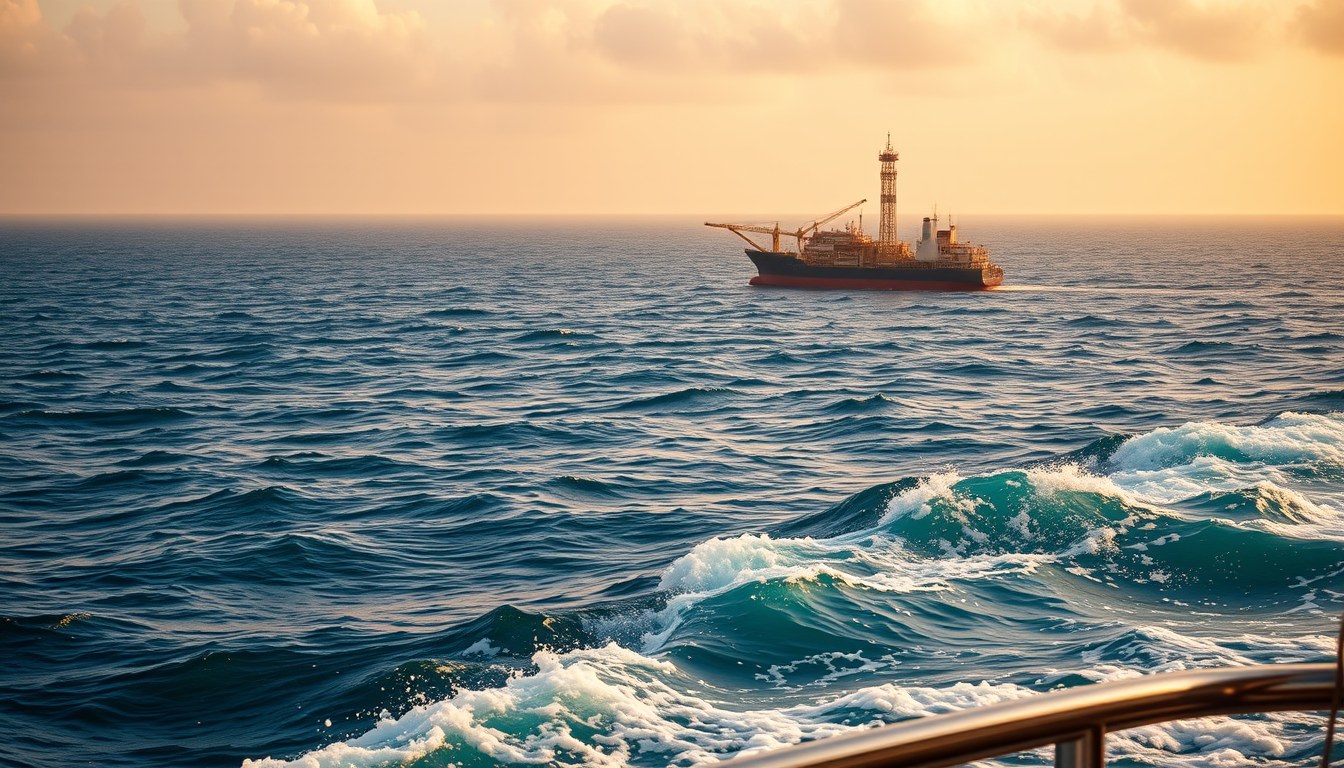
Suriname has its second offshore megadecision, and its first for gas. In Paramaribo on Thursday 26 November, Petronas and Staatsolie announced the final investment decision (FID) for a floating liquefied natural gas (LNG) project in Block 52. The field known as Sloanea now carries the name KrakaWi, which comes from Sranantongo and stands for cooperation and joint strength.
Petronas is the operator with 80%. Paradise Oil Company, a Staatsolie subsidiary, holds the other 20%. First gas is planned for 2030, and Staatsolie has asked its Malaysian partner to deliver it in the first half of that year. Petronas chief executive Tengku Muhammad Taufik announced the decision in the presence of President Jennifer Simons and Vice-President Gregory Rusland.
From awkward find to investment case
Gas was not the prize explorers were after. Staatsolie chief executive Annand Jagesar recalled that the partners were looking for oil at Sloanea, and that the gas they found at first appeared to have poor commercial prospects. Block 52's production-sharing contract dates from 2013. The Sloanea-1 well was drilled in late 2020, an appraisal well followed in 2024, and Staatsolie approved the commercial field on 11 November 2025. At the time, it said the FID was planned for the second half of 2026, with first gas expected in 2030. Thursday's decision falls within that window.
The development concept combines gas wells, subsea infrastructure and a floating LNG facility, which would liquefy the gas near the field for export by sea. Petronas says it would be the first of its type in the Guyana-Suriname basin.
The talks went to the wire. Jagesar said negotiations between the two state companies were not free of tension, and that a final issue was resolved only in the last two days before the announcement.
Read the volumes carefully
Several numbers are in circulation, and they do not measure the same thing. According to Suriname Herald, Taufik estimated KrakaWi's gas at nearly 4 trillion cubic feet (Tcf). He also cited an estimate of 2 Tcf of reserves. Separately, he said recoverable oil and gas in Block 52 amounts to more than 1 billion barrels. In June, Kaieteur News quoted a Petronas executive as saying that eight discoveries in the block collectively held more than 1 billion barrels of oil equivalent. The same month, OilNOW, reporting on Petronas's environmental filing for Sloanea, cited another gas figure: an estimated recoverable resource of 2.5 Tcf in one reservoir, the Upper Campanian.
Investors and budget planners should not treat the largest gas figure as bankable output. The reports do not explain how these estimates relate to one another, or what classification standard applies. The block-wide barrel figure covers more than this one project. The June report on the filing also described a floating plant with a capacity of 1.5 million tonnes a year and an operating life of at least 25 years. The FID reports reviewed for this article do not confirm that this is the approved design, do not give a plateau production rate and do not say whether environmental approval, still pending in June, has been granted. A published breakdown would settle much.
A US$1.6 billion figure with gaps
At a press conference, Simons put the investment at about US$1.6 billion, Starnieuws reported. She confirmed that the state will participate through Staatsolie and left the financing details to the company. She added that high oil prices had helped to give Staatsolie some financial room.
If US$1.6 billion is the gross project cost and Staatsolie pays in proportion to its stake, its share would be roughly US$320 million. That is our arithmetic, not a disclosed commitment. The scope of the headline number also matters. In February, De Ware Tijd reported that a floating LNG vessel would cost at least US$1 billion. The FID reports do not say what the US$1.6 billion includes, or whether the vessel will be bought, leased or otherwise provided.
Staatsolie is not starting with an empty plate. It is funding a 20% stake in the GranMorgu oil project in Block 58, an investment it puts at US$2.4 billion. In 2025 it raised US$516 million in bonds and secured a US$1.6 billion bank loan. Its projected revenue for that year was about US$802 million. How KrakaWi fits alongside those obligations is a question bondholders are entitled to ask.
Fiscal terms deserve the same daylight. A letter of agreement signed in 2024 provided for a ten-year tax-free period from the start of gas production, a term De Ware Tijd also reported this February. Anyone projecting state income from KrakaWi needs to know how that concession appears in the final terms. A tax holiday does not mean the country earns nothing, since Staatsolie holds equity, but it changes the timing and size of what reaches the treasury.
Gas for export, and perhaps for home
The approved project is built around LNG. The government also wants gas brought ashore. "Gas-to-Shore gaan we zeker doen" (we will certainly do Gas-to-Shore), Simons said, while Rusland cast it as a basis for industrialisation. That is an ambition rather than a sanctioned project. Simons said she talks regularly with her Guyanese counterpart about cooperation, but there is no concrete joint gas plan.
The companies are already looking past KrakaWi. Jagesar sees room for a second gas project at least twice its size, and said an oil project is also in preparation. The FID announced on Thursday covers only KrakaWi. Petronas, now active in eight offshore blocks, began drilling earlier this month in Block 66, where a two-well campaign is testing the Senna and Picolet prospects.
The four-year to-do list
For Surinamese firms and workers, 2030 is close. Simons said companies need help meeting industry requirements and obtaining certificates, and that training must match real jobs. "Heel veel tijd hebben we niet meer" (we do not have much time left), she said. The government says it has made agreements with Petronas on training Surinamese.
The government's own markers are worth tracking:
- Local content: Simons expects a report from the Local Content Board before the end of 2026.
- Skills: Oil, Gas and Environment Minister Patrick Brunings said data on future labour needs should be ready in the first quarter of 2027. According to Simons, the labour mobilisation foundation SAO has trained 900 to 1,200 people so far, against a target of 3,000.
- Law: The government hopes supplementary oil and gas legislation will be passed in 2027.
- Revenue: It wants to amend the Savings and Stabilisation Fund law, with a plan covering savings, development investment and social provisions.
The last item may matter most. Simons argues that Suriname's investment backlog means it cannot simply copy Norway's model. That is a defensible position, but it makes the rules on how much to save, and who may spend the rest, all the more important. KrakaWi has cleared its commercial hurdle. The state now has until first gas to show that its institutions can clear theirs.
Sources & further reading
- Starnieuws: Suriname krijgt eerste offshore gasproject, FID KrakaWi een feit (Dutch)
- Starnieuws: KrakaWi vergt investering van US$ 1,6 miljard (Dutch)
- Starnieuws: Na KrakaWi, groter gasproject en olieontwikkeling in het vizier (Dutch)
- Suriname Herald: Petronas estimate of Block 52 gas (Dutch)
- Suriname Herald: Staatsolie sees room for two more projects (Dutch)
- Suriname Herald: Simons on training (Dutch)
- ABC Suriname: Petronas to announce Block 52 FID this week (Dutch)
- Staatsolie: Commercial field approval for Sloanea-1
- The Star (Malaysia): Petronas declares commerciality of Sloanea
- Staatsolie: 2025 results and financing
- OilNOW: Staatsolie's GranMorgu loan (May 2025)
- Kaieteur News: Block 52 discoveries (June 2026)
- OilNOW: FLNG route for Sloanea (June 2026)
- De Ware Tijd: Second investment decision expected (February 2026, Dutch)
- OilNOW: Block 52 outlook and 2024 letter of agreement
- Related: Guyana's US$100m Gas Top-Up: A Warning for Suriname's Sloanea