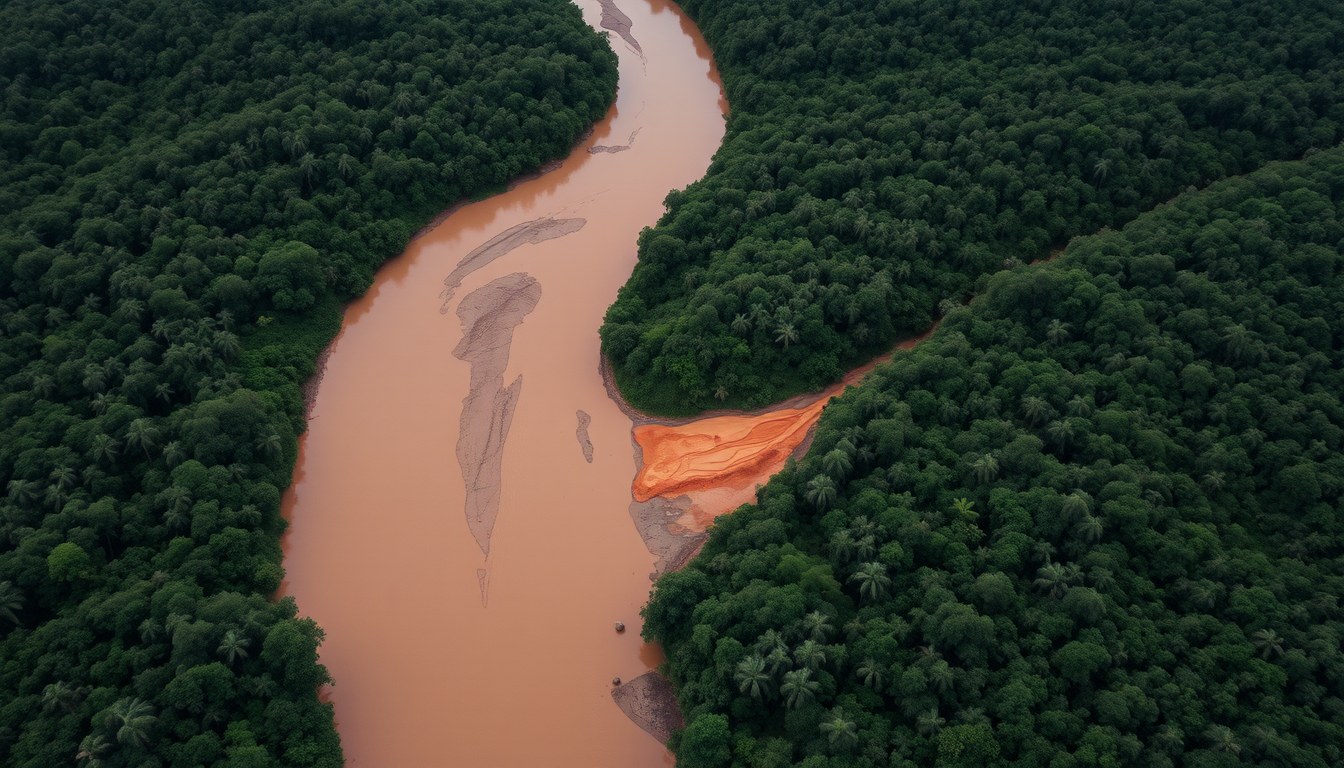
In the space of two weeks, the two Guianas told gold capital very different things. On 27 August President Jennifer Simons told Suriname's National Assembly that she had asked Natural Resources Minister David Abiamofo to temporarily halt the issuance of new concessions, after tests found heavy metals and cyanide linked to pollution of the Saramacca river. On 10 September, across the Corantijn, Guyana signed a mineral agreement with Mako Mining Corp. and its subsidiary Stronghold Guyana Inc. for the Eagle Mountain gold project, locking in ten years of legal and fiscal stability.
Neither move is wrong on its own. Taken together, though, they show the trade-off facing every gold jurisdiction on the Guiana Shield. One option offers investors predictability. The other reasserts control over a sector that, by the president's own account, has gone unchecked for years. Suriname now has to show that its tightening leads to a better framework, not just a longer queue.

What Guyana actually signed
The agreement is between Mako and the Government of Guyana together with the Guyana Geology and Mines Commission (GGMC), according to Mako's release. It was signed by Natural Resources Minister Vickram Bharrat, Mako chief executive Akiba Leisman and Mako president Steve Parsons, according to the Department of Public Information. The government called the signing "an important milestone" in developing the Eagle Mountain gold resource.
The details are in Mako's own release. For ten years the agreement provides legal stability for mining licences, prospecting licences and authorisations, plus fiscal stability, subject to environmental provisions. After that, the parties may renegotiate in good faith or renew on the same terms. The release describes the royalty and tax terms only as consistent with the standard terms of earlier Guyanese mineral agreements; no rates were published. Annual community funding must start within 24 months of the mining licence being granted or 12 months after production begins, whichever comes first. Mako will also make an annual contribution to the ministry's training centre.
The project has not been built yet, and its environmental authorisation is still pending. Mako submitted its environmental and social impact assessment (ESIA) to Guyana's Environmental Protection Agency in March 2026. The public comment period closed in June, and Mako expects to file the final ESIA in the fourth quarter of 2026, with a permitting decision to follow. The government expects construction to start by the third quarter of 2027 and gold production to begin by the end of 2028, subject to approvals.
A sector Guyana already counts on
Guyana can afford to offer certainty because its gold sector is delivering. Bharrat said gold declarations reached about 233,000 ounces in the first half of 2026, some 25,000 more than a year earlier, Kaieteur News reported. At roughly US$4,100 an ounce, the paper valued that output at about US$955 million. Bharrat added that the half-year target had been met for the first time in eight or nine years. The government projects 510,450 ounces for the full year. A stability deal signed with a listed developer also sends a message to the next one.
Suriname is tightening the screws
In Suriname, the same weeks looked very different. Simons told parliament on 27 August that tests showed high concentrations of chemical substances in Saramacca river water and heavy metals and cyanide in samples of live fish. She said the state-owned Grassalco had received a formal letter because an operator working in its concession had caused the pollution, and that the company would have to help bear the cost of supporting affected residents, according to the government's account. Besides the pause on new concessions, the government wants concessions to be made public. The next day Simons met traditional leaders in Pikin Saron and said inspections would not be limited to the affected area, Key News reported.
In the National Assembly, DNA member Genevievre Jordan reported that skalians, the floating gold dredges, were active again on the Marowijne. Abiamofo replied: "We tolereren het niet meer" (we no longer tolerate it). He said that of the more than 20 skalians once active, only three or four remain, and that the Public Prosecutor's Office had to be brought in, according to Key News.
On 23 September Rosebel Gold Mines, which Zijin took over in 2023, said it holds only exploration rights at Overman, including Pelinbergi. It said it identified unauthorised mining there in January 2020 and reported it to the authorities that same month. According to RGM, the illegal miners have kept it from exploring on safety grounds. The company also voiced concern about reported chemical use and asked the government for coordinated inspections and legal action, Key News reported.
Control is not yet a framework
Suriname's crackdown is overdue. If, as RGM says, a titleholder has waited more than six years for its ground to be cleared, rights on paper clearly do not guarantee access in the field. But a freeze, raids and prosecutions are tools, not a regime. Investors will look for what Guyana has just put in writing: who gets a concession, on what terms, for how long, and what happens when the rules change.
That means three things. Suriname should publish the criteria for lifting the pause. It should set environmental conditions that apply to every titleholder instead of negotiating them case by case. And it should show that holders of legal rights can count on the state to enforce them. If the pause ends with clearer rules, Suriname will have traded a few months of permitting for a sturdier sector. If it turns into a backlog, gold investors on the Shield have an obvious alternative across the river.
Sources & further reading
- GOV.SR: President maakt parlement deelgenoot van resultaten onderzoek verontreiniging Saramaccarivier (27 Aug 2026)
- DPI Guyana: Government signs mineral agreement with Mako Mining for Eagle Mountain gold project (10 Sept 2026)
- Mako Mining: Mineral agreement with the Government of Guyana (10 Sept 2026)
- Stock Titan: Mako Mining release, full text (10 Sept 2026)
- Kaieteur News: Gold declarations hit US$955m by mid-2026 (17 July 2026)
- Key News: Saramacca river pollution, government to assist affected communities (30 Aug 2026)
- Key News: DNA-lid Jordan: skalians actief op Marowijnerivier (4 Sept 2026)
- Key News: RGM: illegale mijnbouw in Overman belemmert exploratie (23 Sept 2026)
- Suriname Guyana Corridor: A New Economic Axis
- One Year of Simons: The Honeymoon Is Over