President Jennifer Simons has drawn a line that Paramaribo's landlords and developers should read twice. Speaking on Radio ABC's Welingelichte Kringen on Sunday 4 October, she said the arrival of expats must not push Surinamese out of the housing market, pointing to the experience of other countries that have gone through similar developments. Her remedy, as reported, was not a cap or a tax: investors, she said, should be encouraged to build separate homes for expats (Waterkant; GOV.SR; Key News).
On its own, that is a soundbite. Read alongside the start of a Chinese-donated social housing project at Reeberg and a review of land conversions, it looks like the outline of a policy. wimpel.online's reading: Suriname is moving towards a two-track housing market, with state-backed housing for citizens and privately financed housing for the oil workforce.
Oil money for houses, by law
Simons tied housing directly to future oil revenue. She wants the law on the Savings and Stabilisation Fund Suriname (SSFS), established in 2017 and amended in 2024 over the Value Recovery Instrument, to be amended again so that the fund's resources serve three purposes: saving and stabilisation, development investment, and a limited share for housing and healthcare. Crucially, she wants the investment criteria fixed in law. "De regering moet niet zomaar zelf kunnen bepalen waarin allemaal geïnvesteerd zou moeten worden," she said, meaning the government should not simply be able to decide for itself what to invest in (Waterkant; GOV.SR).
On the ground, the state's role is framed as enabler rather than builder. Simons said the state should keep providing access to land and make low-interest loans possible. The government has begun preparing land for construction and laying utilities, so that citizens would in principle pay only for the house itself (Key News; GOV.SR).
Reeberg: the citizen track breaks ground
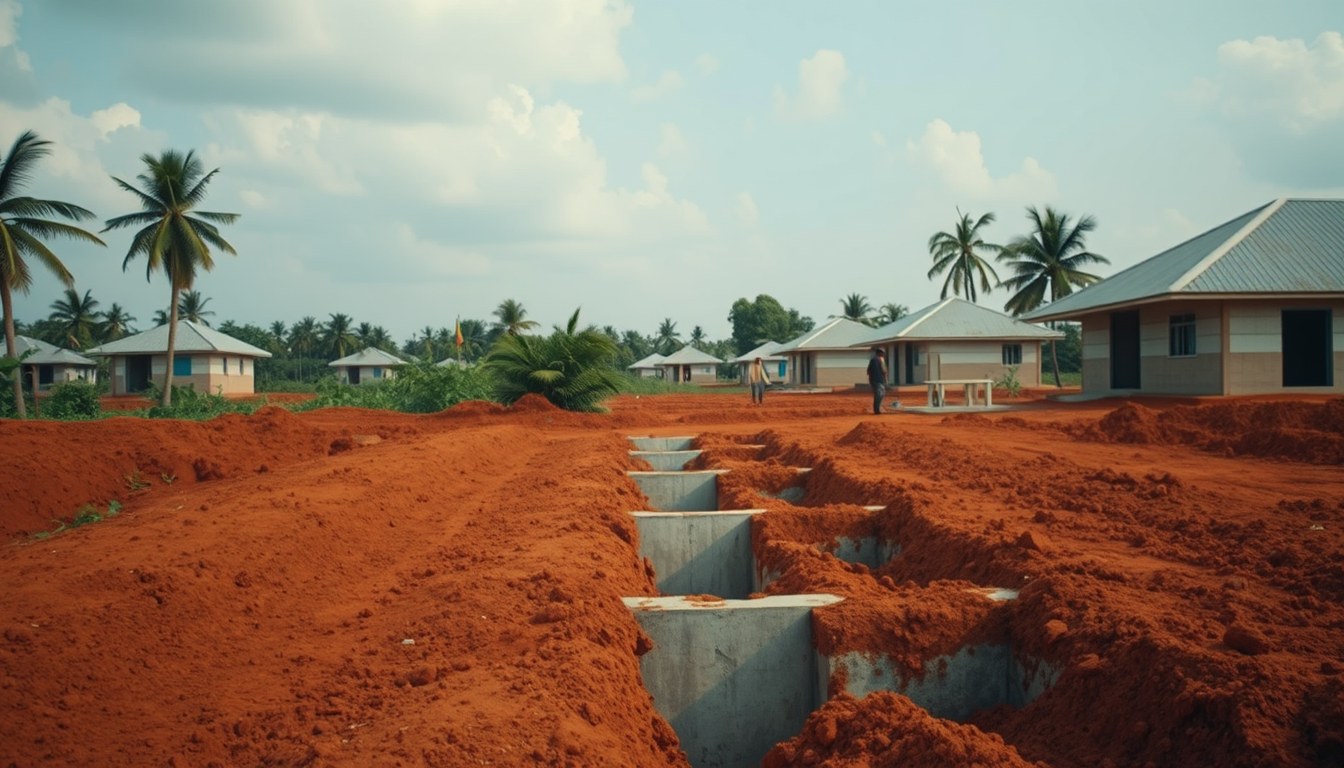
On Monday 12 October Simons and Stephen Tsang, Minister of Public Works and Spatial Planning, started construction of 350 social homes at Reeberg, a donation from the Chinese government and people, intended for socially needy households. Tsang said the homes must be completed within two years, with the contractor responsible for a further two years of maintenance: a four-year project in all (Suriname Herald; De West). Neither the Suriname Herald nor De West named the contractor or put a value on the project.
The project has a long history. According to the government's information service, it has been planned since 2017; Tsang said mismanagement on the Surinamese side contributed to delays and to the loss of 102 homes within the original budget, after which the Chinese government decided to carry out the project at its original size of 350 homes (GOV.SR).
The financing architecture around it matters more than the 350 units. According to the Suriname Herald and De West, SRD 250 million is reserved in 2026 for the Woningbouwfonds, which offers mortgages at favourable rates, and financing options of 3, 5 and 7 percent interest were mentioned in connection with NaHuSur, the national housing programme, where interested citizens can find out whether they qualify for a home. Council adviser Faizal Abdoelgafoer added that the president does not want one target group concentrated in one location, but a mix of social and economic groups (Suriname Herald; De West).
Land: from speculation to use
The third piece is land. On 4 October the Suriname Herald reported that Bronto Somohardjo, PL faction leader and chair of the National Assembly's standing committee on Land Policy and Forest Management, had described land conversion as "een vorm van witwassen", a form of money laundering, arguing that land could be converted and resold without enough questions being asked about the origin of the money, and that political leaders had failed on land policy for 50 years (Suriname Herald). It is not a new position: in July De West already reported him arguing that land conversion had been used to facilitate money laundering and calling for a thorough evaluation of the scheme (De West). These are his allegations; no court or official finding to that effect has been reported.
On Friday 30 October Minister Melvin Bouva announced, on behalf of the president, that the government will evaluate the land conversions of 2020-2025, with particular attention to transfers of state land to companies and foundations without demonstrable public benefit. Land issuance is to be tied more strictly to actual use, and the government says it wants to curb speculation. Bouva spoke as land documents were handed to more than 900 recipients in Wanica. "Wij willen rechtszekerheid voor onze burgers," he said: we want legal certainty for our citizens. Uraiqit Ramsaran, acting Minister of Land Policy and Forest Management, acknowledged backlogs in the land administration and the many citizens who have waited years for their applications to be processed (Suriname Herald; GOV.SR; Starnieuws).
What it means for developers and landlords
For the private market, the message is two-sided. The state is signalling that it intends to serve the lower end of the market through land, prepared plots and cheaper credit. That leaves the expat and corporate segment, which wimpel.online has tracked in its coverage of corporate housing in Paramaribo, explicitly to private capital, with the president's blessing.
- Purpose-built beats conversion. Simons asked for separate homes for expats. Developers who add new stock for the oil workforce align with that signal; landlords who turn existing family housing into expat rentals may find themselves on the wrong side of it.
- Land title is now a due-diligence item. Plots converted between 2020 and 2025, especially state land that passed to a company or foundation, may fall within the scope of the announced review. Buyers and lenders should check the chain of title before committing capital.
- Idle land carries risk. If issuance is tied to actual use, land banking becomes harder to justify.
The details of the SSFS amendment and the land review will decide how sharp the line becomes. The direction of travel is already clear enough to price in.
Sources & further reading
- Waterkant: Simons wil olie-inkomsten inzetten voor wonen en zorg (5 Oct 2026)
- GOV.SR: President Simons deelt inzichten over verdeling middelen Spaar- en Stabilisatiefonds
- Key News: Simons wants to allocate oil revenues to savings, development and care (10 Oct 2026)
- Suriname Herald: President Simons luidt bouw van 350 sociale woningen te Reeberg in (13 Oct 2026)
- Waterkant: China schenkt Suriname 350 sociale woningen, bouw in Reeberg gestart (13 Oct 2026)
- De West: China maakt bouw 350 sociale woningen te Reeberg mogelijk (14 Oct 2026)
- GOV.SR: Bouw van 350 sociale woningen te Reeberg officieel van start
- Suriname Herald: Somohardjo noemt grondconversie vorm van witwassen (4 Oct 2026)
- De West: Somohardjo: 'Grondconversie gebruikt om witwassen te faciliteren' (4 Jul 2026)
- Suriname Herald: Regering Simons neemt grondconversies onder de loep (31 Oct 2026)
- GOV.SR: Breder huisvestingsbeleid centraal bij uitreiking ruim 900 grondpapieren in Wanica
- Starnieuws: Regering pakt grondspeculatie aan en onderzoekt grondconversies 2020-2025
- Corporate Housing Paramaribo: The Untapped Boom
- Paramaribo's Rental Market Is Broken by Oil