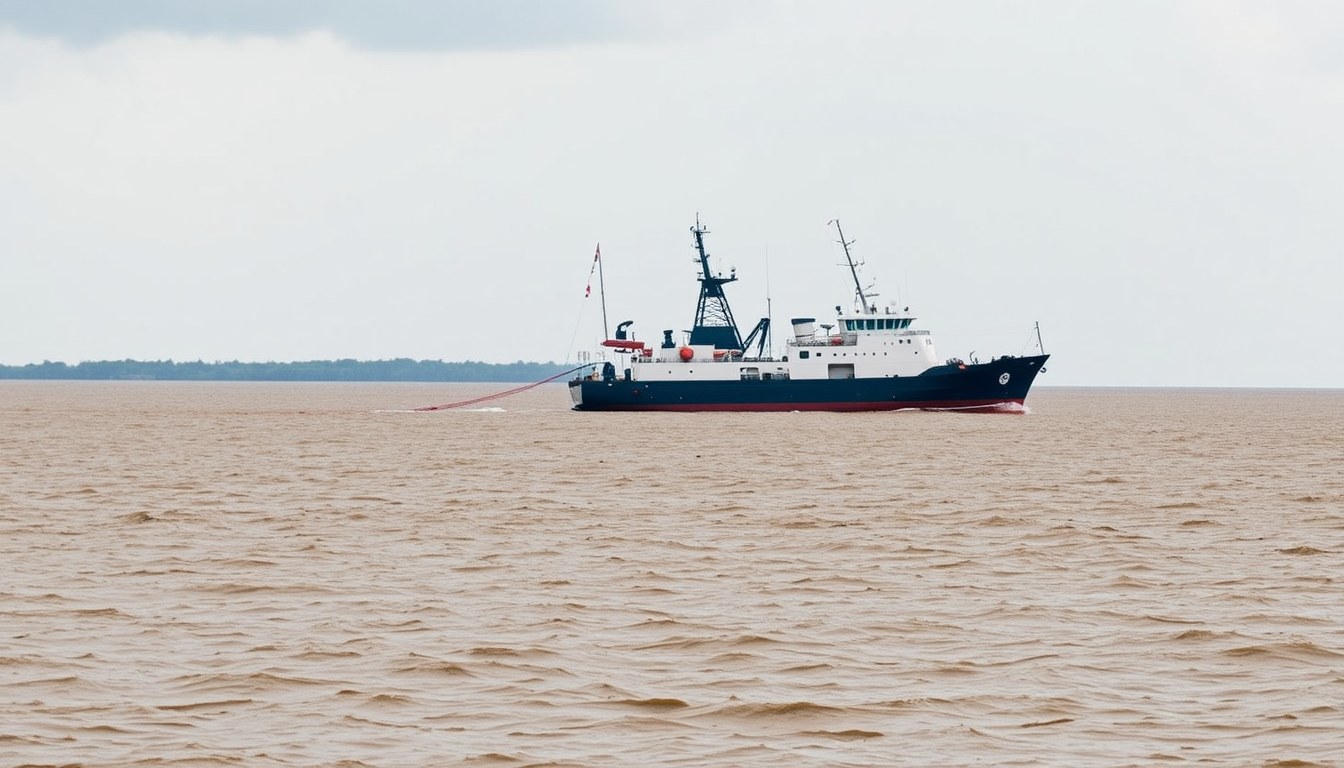
For several years now, Suriname's oil story has been told far offshore. GranMorgu is the project everyone watches. On 17 September Staatsolie general director Annand Jagesar told President Jennifer Simons that the company is still on track for first oil in 2028 (Dagblad De West). Two Staatsolie notices in the past eight days point somewhere else: the shallow shelf between the coastline and the deepwater blocks.
On 22 September the state oil company said it had received an Open-Door proposal for an area in Sector 1: SHO West of the Open Acreage offshore Suriname. Qualified companies now have 90 days to submit competing proposals, from 22 September to 21 December 2026 at 10:00 local time (Staatsolie). On 30 September it announced plans for its own 2D and 3D seismic surveys in the Shallow Offshore Area, to understand the subsurface and the possible presence of oil and gas (Staatsolie).

An open door, now on both flanks of the shelf
Staatsolie launched the Open-Door Offering on 24 November 2025. It puts roughly 60 percent of Suriname's offshore acreage on the table, from shallow water to deep offshore. Companies choose their own acreage and propose a work programme under either a production sharing contract or a joint study or technical evaluation agreement. Once a proposal comes in, the acreage is published and rivals have 90 days to compete (Staatsolie).
Uptake has been quick. By early July Staatsolie had four proposals: one for Sector 4 (DW West) on 17 June, two for Sector 3 (Demerara) on 6 July and one for Sector 2 (SHO East) on 7 July (Suriname Energy). The SHO East competing window closes on 5 October (Staatsolie). SHO West is the first proposal in Sector 1, which means the shallow-offshore sectors on both the eastern and western sides of the shelf are now in play. Staatsolie has not said who submitted the SHO West proposal, and wimpel.online will not guess.
Why Staatsolie is buying its own data
The shelf is not new ground for seismic. On 20 November 2025, a survey of about 2,000 km² began off Saramacca and Coronie in 20 to 50 metres of water. BGP Offshore and TGS ran it on a multi-client basis: the consortium can sell the data to third parties, while Staatsolie owns the data and takes a share of the sales (Staatsolie).
The new programme is Staatsolie's own, and it has been a long time coming. A March notice described a limited EIA over a study area of about 41,600 km², reaching roughly 110 km offshore in 0 to 70 metres of water. It mentioned an initial survey of around 2,000 km², expected in the third quarter and lasting about two months (Staatsolie). By May the scoping notice described a larger area: about 52,400 km², with water depths of up to roughly 500 metres (Staatsolie). The 30 September notice gives no start date, duration or survey boundaries. With the EIA still in public consultation at the end of the third quarter, the original timetable appears to have slipped.
In wimpel.online's reading, the logic is commercial. In an open-door system the state does not set the pace by running bid rounds; it sets the pace by what companies can see. Proprietary 2D and 3D coverage of the shelf would give Staatsolie its own view of prospects that bidders are already circling. That could matter most when it has to judge competing proposals and work programmes within a 90-day window.
What the EIA stage means for fishers and suppliers
ILACO Suriname has completed the environmental impact assessment, and the findings are set out in an Environmental Impact Statement published online. An online stakeholder meeting on Microsoft Teams is scheduled for 12 October, from 13:00 to 15:00. The presentation will be in Dutch and the slides in English. Registration runs through ILACO or Staatsolie (Staatsolie).
- Fishers should read the EIS before the meeting. Coastal fleets work in the same waters as shallow surveys. During the 2025 survey, support vessels kept fishing boats and commercial ships at a safe distance from a vessel towing eight six-kilometre streamers (Staatsolie).
- Local suppliers of chase and support vessels, crew transfer, logistics and environmental monitoring should treat the consultation as an early signal of demand, not a formality.
- Survey contractors will be watching for a procurement step, which Staatsolie has not yet announced.
A different kind of development
If the shelf yields commercial finds, they would probably not look like GranMorgu. Shallow water usually allows simpler, cheaper infrastructure and shorter supply lines to the coast. It also brings closer contact with fishing grounds and coastal communities. That combination could favour Suriname-based contractors more than a deepwater megaproject does, provided they are ready if drilling follows. For now there are no discoveries, only data and proposals. But Staatsolie's September notices show that the next exploration wave is being prepared closer to shore.
Sources & further reading
- Staatsolie: Open-Door proposal received in Sector 1: SHO West (22 Sept 2026)
- Staatsolie: Invitation to stakeholder meeting, shallow offshore seismic survey (30 Sept 2026)
- Staatsolie: Announcement of seismic survey (19 March 2026)
- Staatsolie: Scoping stakeholder meeting, shallow offshore seismic (6 May 2026)
- Staatsolie: Staatsolie launches Open-Door Offering (24 Nov 2025)
- Staatsolie: Seismic study initiated in shallow offshore (Nov 2025)
- Staatsolie: Proposal received in Sector 2: SHO East (7 July 2026)
- Suriname Energy: Staatsolie receives fourth open acreage proposal (July 2026)
- Dagblad De West: Staatsolie informeert President (19 Sept 2026)
- GranMorgu at Halfway: What 50 Percent Means
- Local Content 2026: The Real Test Begins Now