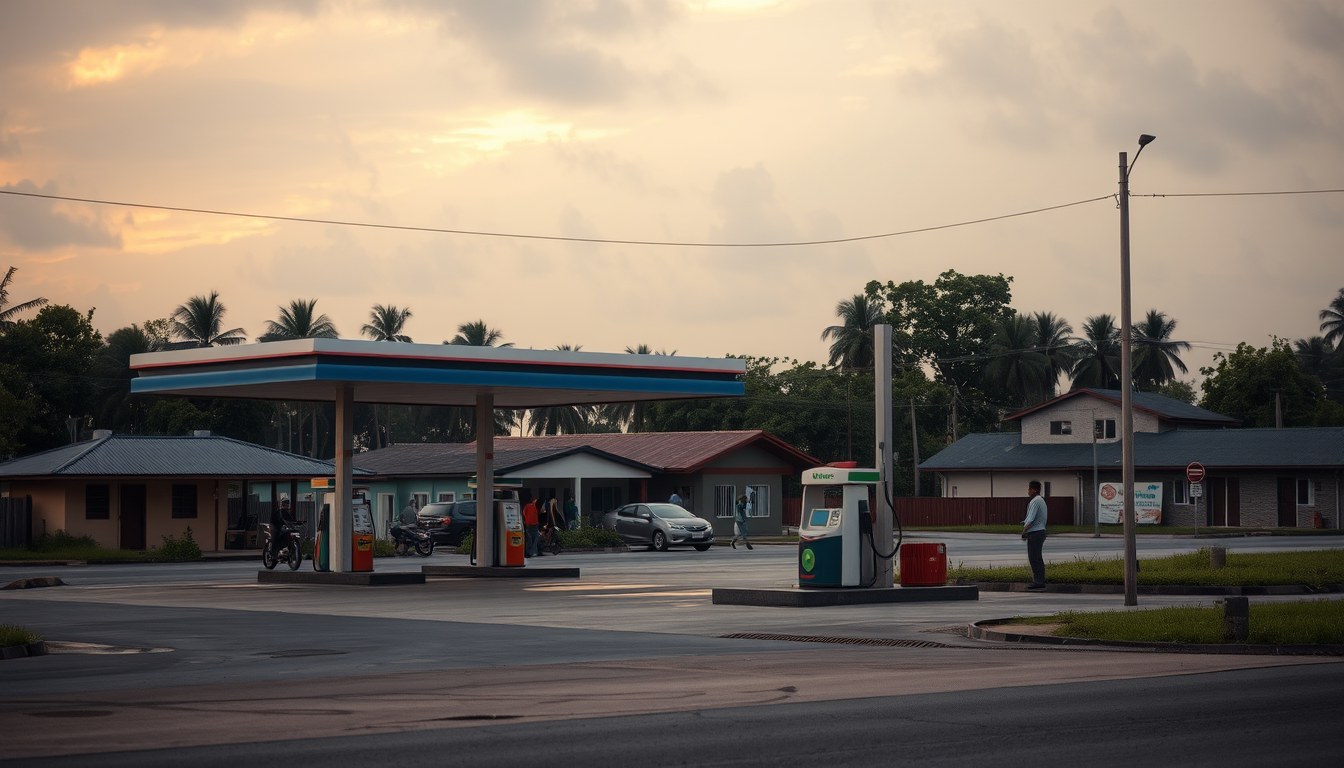
Finance Minister Adelien Wijnerman has finally put a price on Suriname's fuel cap. At a press conference on Friday 21 August, she said the maximum pump prices introduced in March cost the state about SRD 350 million a month, and about SRD 1.4 billion in total through July (figures also reported by Starnieuws). No decision has yet been taken on when, or how, the cap will come off.
The latest figures from the General Bureau of Statistics (ABS) show annual inflation easing to 8.9% in July. On the surface, the cap is working. The harder question is whether it is buying price stability or simply moving the bill from the pump to the budget.
A subsidy that does not look like one
The cap was set in mid-March as world oil prices climbed; the government gives 18 March as the start date for new cargoes, while De Brief reported 17 March. GOw2 raised its prices to the ceiling: SRD 53.27 a litre for diesel and SRD 48.32 for unleaded. The mechanism is not a cash handout. According to Ms Wijnerman, the state forgoes part of its government take on fuel and pays oil companies the difference under the maximum price.
The risk was flagged early. On 25 March Edgar Dikan, coordinator of the presidential Crisis Management Team, warned that once the gap grew larger than the government take, the state would have to pay out of its own pocket. Five months on, the bill has a number. At SRD 350 million a month, every quarter the cap stays in place costs a little over SRD 1 billion, and that cost appears nowhere as a single budget line.
What the July CPI really shows
The ABS release shows consumer prices up 0.5% on the month in July and 8.9% on the year, down from 10.4% in June. The cap's fingerprints are clear in the detail. The ABS fuel index stood at 1077.0 in May, June and July: frozen. In Paramaribo and Wanica, the transport index was unchanged between May and June and rose just 0.1% in July.
Set the Paramaribo and Wanica indices against July 2025 and the picture splits in two (wimpel.online's calculation from ABS figures):
- All items: 973.4 against 889.2, up about 9.5%
- Food and non-alcoholic beverages: 1087.4 against 979.1, up about 11.1%
- Transport: 1020.6 against 979.3, up about 4.2%
Health care in the same region rose about 27.4% over the year, and in July individual item prices ranged from a 55% fall to a 288% rise. The cap holds one line of the index steady. It does not tame the rest, and households feel the price of food far more than a transport index that has stopped moving.
The wage trap
The cap now sits at the centre of the public-sector pay talks. The government's first offer is a 10% rise; the Ravaksur union federation wants 25%. Ms Wijnerman tied the two together bluntly: "Als de overheid loslaat en loonsverhoging geeft, betekent de verhoging niets" (roughly: if the government releases fuel prices and grants a raise, the raise means nothing). She added that fuel prices are not expected to fall below today's level.
That is the bind. A 10% raise barely clears 8.9% headline inflation while the cap is in place. Lift the cap, and part of that raise is absorbed at the pump. Keep it, and the state pays twice: once through a larger wage bill, and again through forgone fuel revenue. The ministry says options including a phased withdrawal are under study, in consultation with President Jennifer Simons, but, in the minister's words, "We zijn nog aan het bestuderen wat de aanpak zal moeten zijn en op welk moment."
Fiscal arithmetic with little room
A new Inter-American Development Bank report puts the problem in context. Suriname's fiscal deficit widened from about 3.4% of GDP in 2024 to 9.6% in 2025, which the IDB links partly to higher subsidies. The 2026 budget projects about 5.1%; the IMF projects 4.7%. Public debt stood at 100% of GDP in 2025. Growth is forecast at about 3.9% this year, before a one-off jump to 28.5% in 2028, when GranMorgu is expected to bring first oil.
The IDB wants to prevent resource flows from driving "short-term, procyclical spending". In wimpel.online's view, an open-ended fuel subsidy, priced off a world oil market the government does not control, is exactly the kind of commitment that makes a deficit target hard to hit. As the Suriname Herald reported, Ms Wijnerman herself says the scheme cannot continue indefinitely.
Our verdict: the cap has bought a calmer inflation print and political breathing room during wage talks. It has not bought price stability. It has deferred an adjustment and parked the cost in the budget. The sooner the government publishes a timetable and a monthly cost figure, the less the eventual exit is likely to hurt.
Sources & further reading
- Government of Suriname: Regering nog in beraad over brandstofcap en loononderhandelingen (21 August 2026)
- Starnieuws: Ruim SRD 1,4 miljard derving door brandstofcap (22 August 2026)
- Suriname Herald: Brandstofsubsidie kost staat SRD 350 miljoen per maand (24 August 2026)
- Government of Suriname: Price cap brandstof nodig, maar niet onbeperkt houdbaar (25 March 2026)
- ABS: Consumentenprijsindexcijfers en inflatie over juli 2026
- Caribbean Today: IDB says Suriname's medium-term economic outlook is favourable (26 August 2026)
- De Brief: Surging oil prices and inflation grip Surinamese economy (30 March 2026)
- The IMF Verdict on Post-Election Suriname 2026
- One Year of Simons: The Honeymoon Is Over