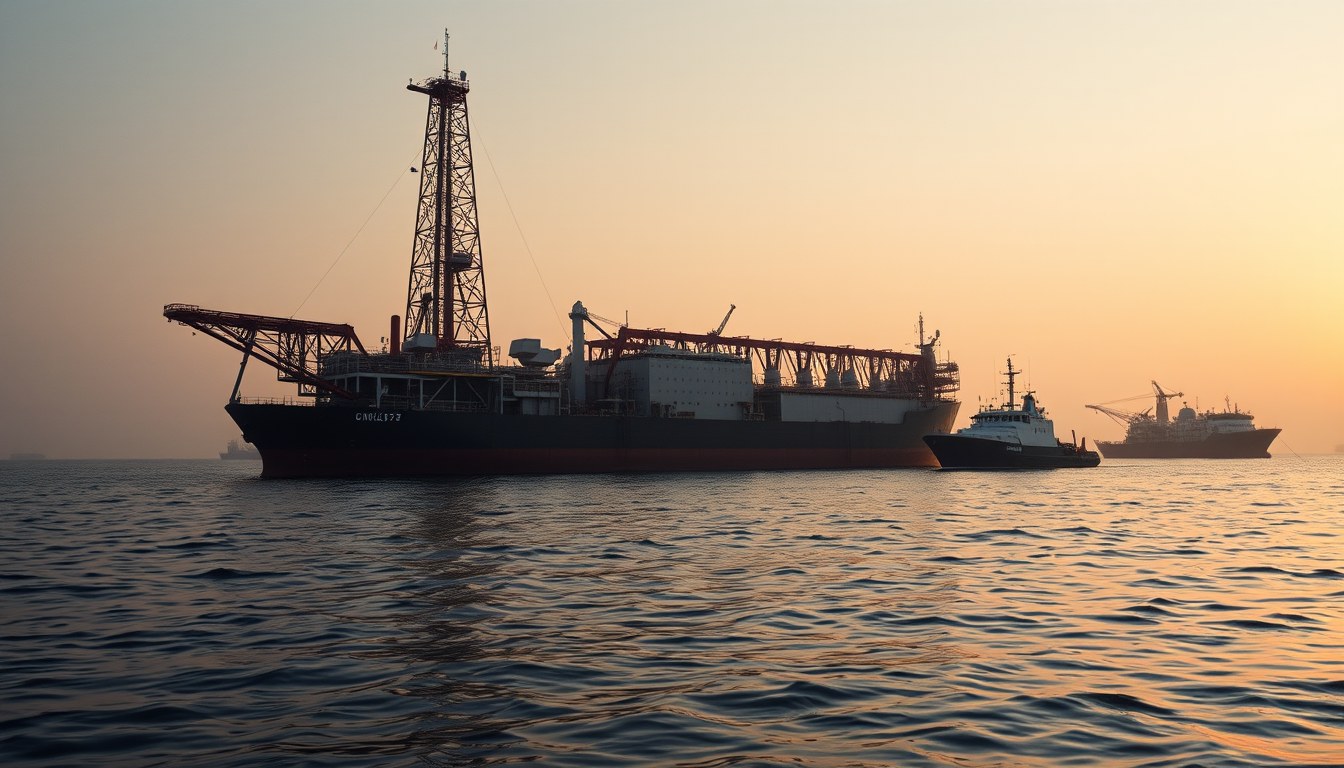
Suriname's first oil project is still roughly a year and a half from start-up, but its partners are already drilling for the sequel. With its third-quarter 2026 results, published on 4 November and discussed on an earnings call on 5 November, APA Corporation said two exploration wells are planned offshore Suriname with its partner TotalEnergies, targeting additional resource potential that could extend GranMorgu's production plateau or even support a second development, as chief executive John Christmann put it, according to the transcript and Oil & Gas Journal.
That is a meaningful shift in tone. Until now, the public conversation in Paramaribo has focused on getting the first barrel out on time. APA's guidance signals that the partners in Block 58 are already thinking about what comes next, and that the answer will be decided by the drill bit.

What APA actually said
According to the earnings call transcript, Christmann told investors that TotalEnergies continues to advance GranMorgu on budget and on schedule for first oil in mid-2028. He also reminded analysts of the carry arrangement under which APA funds only 10% of GranMorgu's development capital while keeping its 40% working interest. Chief financial officer Ben Rodgers put third-quarter upstream investment at $466 million, about $30 million below guidance, mostly because GranMorgu spending shifted into the fourth quarter.
Christmann said the new prospects are very similar to the Krabdagu and Sapakara discoveries that underpin GranMorgu, and that because the wells sit inside the current development area, they will be cost recoverable. For 2027, APA gave a preliminary upstream capital estimate of roughly $2.5 billion; its earnings release says exploration and GranMorgu development account for about 60% of the roughly $400 million year-on-year increase. BNamericas reported that APA has earmarked about US$250 million for Suriname in 2027. Exploration spending is set to return to APA's targeted range of 10% to 15% of annual upstream capital, a point also reported by Hart Energy, which placed the two Suriname wells in 2027 alongside APA's exploration plans in Alaska and Uruguay.
Asked by an analyst about relinquishment, Christmann said APA has not relinquished any part of Block 58 and still has time and some work to do with Staatsolie on the block.
Why the plateau matters more than the peak
GranMorgu reached its final investment decision in October 2024 on more than 750 million barrels of recoverable resources. For a small economy, the length of the production plateau is arguably more important than the headline peak rate: it determines how many years of steady government take, Staatsolie participation revenue and supplier contracts the country can plan around.
Extra barrels tied back to the existing FPSO would likely be the cheapest way to lengthen that window, and the location of the wells inside the development area points in that direction. A genuinely separate second development would be a different proposition, implying a new investment decision, a new round of local-content commitments and fresh scrutiny of fiscal terms. APA explicitly floated both outcomes; neither is committed.
The macro backdrop has improved
The timing is helpful for the state. On 9 November, S&P Global Ratings upgraded Suriname to 'B-/B' from 'CCC+/C', citing GranMorgu, developed by TotalEnergies, APA and Staatsolie, and its expected start by mid-2028. A credible pipeline beyond the first project would strengthen the case that oil revenue is not a one-off.
But the domestic energy picture shows the gap between offshore promise and onshore reality. Gerard Lau, chairman of the supervisory board of the Energy Authority Suriname, has put the current power deficit at 80 to 100 megawatts, rising to about 120 megawatts depending on weather and water levels in the reservoir, according to BNamericas. Exploration success offshore does nothing for that shortfall in the near term.
What Paramaribo should watch
- Well locations and timing: APA has said the wells lie inside the current development area but has not published precise locations or a spud schedule. That disclosure will show how much is near-field tie-back potential and how much could seed a standalone hub.
- Staatsolie's role: As the state partner, Staatsolie's stance on relinquishment and on exploration funding will shape how much of any upside flows to the treasury.
- Policy readiness: If a second development becomes real, the fiscal, savings-fund and local-content framework should be settled before the next investment decision, not negotiated during it.
The bottom line: GranMorgu is no longer just a project to be delivered. For its partners, it is also a platform to be extended. Suriname's institutions need to be ready for that conversation by the time the well results arrive.
Sources & further reading
- APA Corp Q3 2026 earnings call transcript (The Motley Fool, 5 November 2026)
- APA Corporation Q3 2026 earnings release (SEC filing, 4 November 2026)
- Oil & Gas Journal: APA to beef up exploration spending in 2027 (5 November 2026)
- BNamericas: APA earmarks US$250mn for Suriname in 2027
- Hart Energy: APA's Permian Cash Flow Helps Fund Search for New Oil Discoveries (6 November 2026)
- S&P Global Ratings: Research Update, Suriname upgraded to 'B-/B' (9 November 2026)
- BNamericas: Rapid investments necessary to address energy shortage in Suriname
- APA Corporation: Suriname portfolio
- Petroleum & Energy Insights: Suriname, a Palimpsest of Two Billion Years
- Rewriting the Oil Fund Law Before the First Barrel