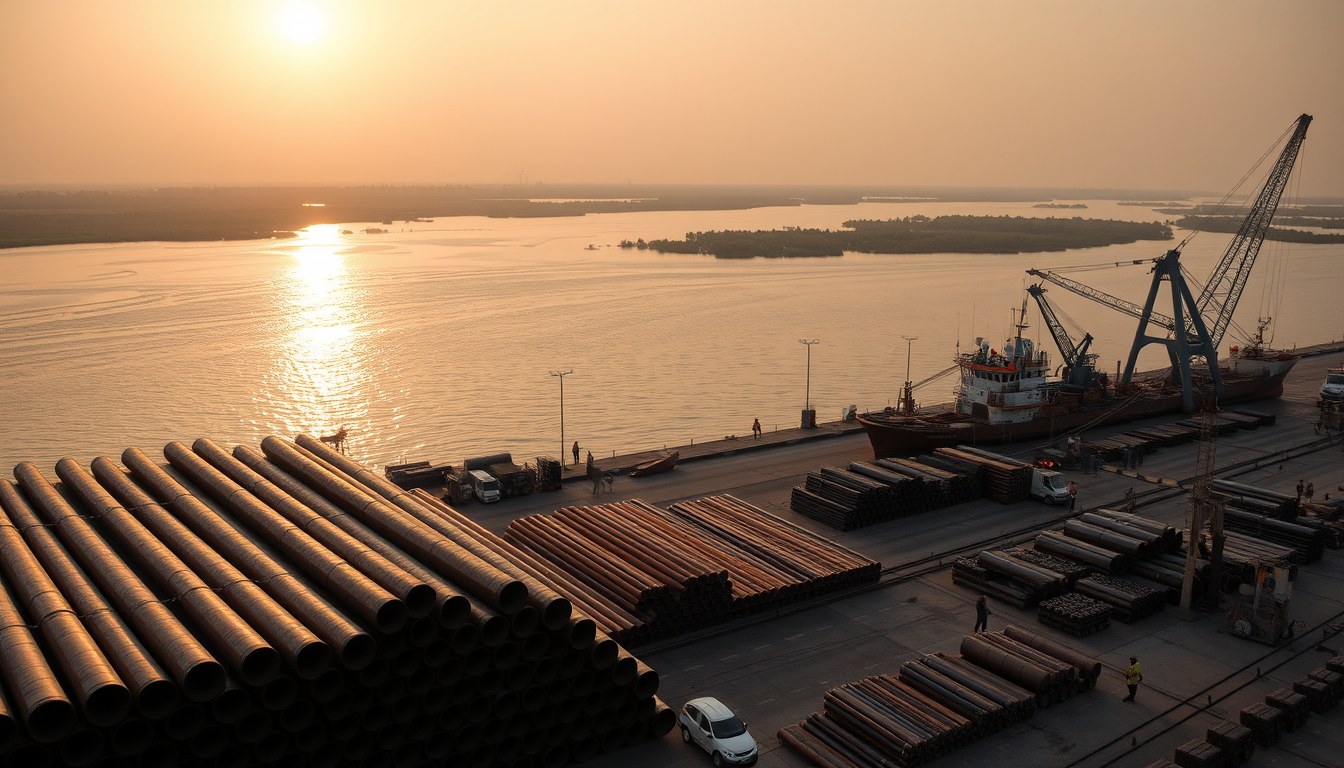
When the chief executive of one of the world's largest energy companies walks a port quay in Paramaribo, it says something about where his company's money is going. On 19 September 2026 Patrick Pouyanné, Chairman and CEO of TotalEnergies, visited Suriname with Nicolas Terraz, President of Exploration & Production, and Javier Rielo, Senior Vice President for Exploration & Production Americas, according to Staatsolie. Reuters, reporting from Paramaribo the same day, quoted Staatsolie chief Annand Jagesar as saying the project is on track for first output in mid-2028.
The delegation met President Jennifer Geerlings-Simons and Staatsolie Managing Director Annand Jagesar, then toured the port where much of the GranMorgu logistics work takes place: the Kuldipsingh Port Facility, where large components are stored before installation on the seabed, as Offshore Energy describes it. Read alongside what Pouyanné said there, the visit looks like more than a progress inspection: it signals that TotalEnergies intends to be Suriname's anchor operator for a long time.
The man at the top
Pouyanné, born in 1963 and an engineer trained at École Polytechnique, became chief executive of Total in October 2014 after the death of Christophe de Margerie, and added the chairmanship in December 2015, according to his public biography. That long tenure means the Suriname strategy has been shaped under a single leader, from the first Block 58 operatorship to the current build-out.
How the position was built
The company's Suriname record, as set out on its own country page, reads like a patient accumulation of acreage:
- January 2021: Total became operator of offshore Block 58 and announced a fourth discovery there; further successes followed in July 2021 and February 2022.
- May 2023: production sharing contracts for shallow-offshore Blocks 6 and 8, which it operates with a 40% stake alongside QatarEnergy and Staatsolie subsidiary Paradise Oil Company (Caribbean Energy Week).
- October 2024: final investment decision on GranMorgu, with production scheduled for 2028.
- June 2025: acquisition of a 25% interest in Block 53.
Not every bet has paid off. In Block 64, operated with a 40% stake alongside QatarEnergy and Petronas, a 2025 exploration well came back negative, Caribbean Energy Week reports. Across the border, TotalEnergies operates Guyana's Block S4 with 40%, with the same two partners, under a production sharing agreement signed in November 2025.
GranMorgu as the anchor
GranMorgu develops the Sapakara and Krabdagu discoveries some 150 km offshore. Caribbean Energy Week puts recoverable reserves at nearly 760 million barrels and TotalEnergies' stake at 40%, with APA Corporation and Staatsolie (20%) as partners. The FPSO is designed for 220,000 barrels per day and to accommodate future tie-backs. Cost is where sources diverge: Caribbean Energy Week cites US$10.5 billion, Reuters calls it a US$12 billion project, and Offshore Energy says the initial estimate of about US$10.5 billion could reach US$12.2 billion. Contractors include the SBM Offshore and Technip Energies joint venture on the FPSO, and Saipem, which holds a US$1.9 billion contract.
Speaking at the port during the visit, in footage TotalEnergies later released on social media, Pouyanné framed the halfway point bluntly: "it's a milestone that we are achieving 50% of the project completed and we already spent half of the money," as reported by Ocean Energy Resources. Reuters separately reported Pouyanné as saying the partners have already spent about 50% of the planned investment. On those figures, spending is so far tracking physical progress.
What the leadership is signalling
Two messages stand out. The first is longevity. Pouyanné said the field's life is currently 20 to 25 years, but successful exploration could stretch it to about 40, according to Ocean Energy Resources. TotalEnergies plans four further exploration wells in Block 58 in 2027 and 2028, and Staatsolie confirms a new exploration campaign in Block 58 in 2027 to investigate the area around GranMorgu.
The second is local legitimacy. "The best way to share prosperity with Suriname people is to create local jobs," Pouyanné said in the same footage. The numbers behind that line are real but still modest: the logistics base has grown from 45,000 to 200,000 square metres and employs 225 workers, 99% of them Surinamese, while direct jobs stand at 700 against a target of 2,000, according to Ocean Energy Resources. More than 100 Surinamese companies already supply the project, Staatsolie says.
The state partner is, for now, satisfied. "We appreciate the professionalism and expertise of TotalEnergies," Jagesar said, according to Staatsolie. The harder test comes after 2028, when Suriname will judge TotalEnergies less on schedules than on how much of a potentially 40-year field's value stays onshore.
Sources & further reading
- Staatsolie: TotalEnergies CEO visit underscores progress on GranMorgu project (21 Sep 2026)
- Reuters: TotalEnergies' offshore project in Suriname on track for first output in mid-2028 (19 Sep 2026)
- Caribbean Energy Week: TotalEnergies CEO visits Suriname as GranMorgu advances toward 2028 first oil (24 Sep 2026)
- Offshore Energy: TotalEnergies, Staatsolie and APA advancing $12.2B oil project (21 Sep 2026)
- Ocean Energy Resources: GranMorgu reaches 50% completion ahead of 2027 offshore work (4 Oct 2026)
- BNamericas: Suriname: GranMorgu project takes shape as major production equipment arrives
- TotalEnergies: TotalEnergies in Suriname
- Wikipedia: Patrick Pouyanné
- GranMorgu at Halfway: What 50 Percent Means
- Block 58: Who Really Captures Suriname's Oil?