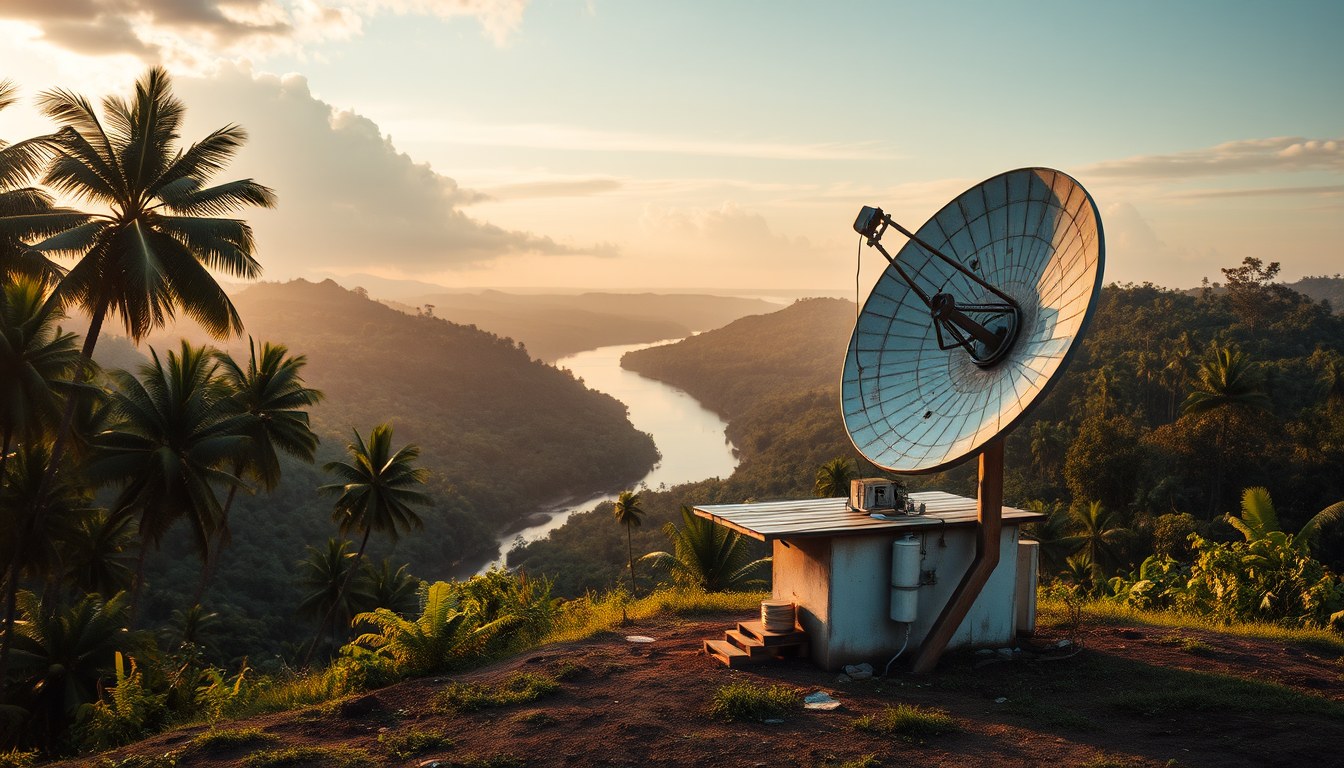
Suriname's National Assembly is being asked to approve accession to ALCE, the Latin American and Caribbean space agency, while the government cannot yet say what membership costs. That is the wrong order of operations. The treaty may well be worth joining. But a state that has just been told by S&P that its institutional capacity is limited should not sign an open-ended financial commitment and work out the bill afterwards.
The facts, as laid out in Friday's public hearing, are unusually plain. According to Starnieuws, committee chairman Ronny Asabina (BEP) said Suriname does not yet know the annual contribution or how it is calculated, nor which ministry or institution will act as national contact point. Almost all the bodies consulted reportedly showed little willingness to take on that role. The Foreign Affairs ministry (BIS) passed the fee question to ALCE's headquarters; no substantive answer had arrived. The committee nevertheless recommends accession, provided the government first clarifies costs, implementation and concrete benefits.

What is actually on the table
Nobody in the debate, as reported, rejected the idea of space cooperation. The case for satellite data is concrete: the committee pointed to disaster prevention, climate monitoring, agriculture and forestry. Members of the Assembly also cited satellite uses closer to the economy's weak spots, such as detecting illegal activity in the interior, according to Starnieuws. Betterson (ABOP) said that satellite data is already used but agencies work too separately, that action sometimes comes only after people have left and the trees are gone, and proposed a sub-directorate for space policy within the Ministry of Defence. Reyme (A20) wants a pilot flood-warning system for the interior in the first year after accession, according to the Suriname Herald.
These are serious uses. Illegal logging and gold mining, floods that hit interior communities, and farm planning all carry real economic costs. The question is not whether satellite data has value. It is whether paying for ALCE membership is the cheapest and fastest way to obtain it, and whether Suriname can absorb the cost.
The unanswered costs
Asabina flagged that the fee is only the start. Participation can add spending on meetings, technical working groups, training, projects and the build-up of a national organisation to process the data. Those are the costs that tend to be underestimated and then quietly underfunded. It is also not yet known which budget line would pay the contribution.
The worry is not abstract. Asabina noted that Suriname often struggles to meet financial obligations to international organisations, and Starnieuws reports that parliamentarians raised the same concern. The Public Works and Spatial Planning minister, according to the same report, supports joining but said that financial constraints might mean accession only after 2028. When a minister says that, it is information, not noise.
NPS member Jeffrey Lau made the sharpest version of the argument: Suriname should not pay for future possibilities while existing solutions go underused. He pointed to cooperation with Brazil announced in May 2026 (and asked what concrete agreements came out of it), Europe's freely accessible Copernicus data, the Amazon Cooperation Treaty Organization, and domestic capacity such as the Forest Cover Monitoring Unit and the GONINI geoportal. He also said ALCE is still at an early stage and may take years to deliver results. That is a business argument, and a good one. It says: use what is free before you buy what is not.
Why this is a fiscal-credibility test
Context matters. On 9 November S&P raised Suriname to B- from CCC+ with a stable outlook. In its response, the Office of the President said the government will prioritise strengthening debt management, financial institutions and compliance with budget rules in 2027 and 2028, according to Starnieuws. The same report says S&P cited limited institutional capacity and an underdeveloped culture of timely debt repayment, with earlier payment problems, as obstacles to a higher rating. At the IMF and World Bank annual meetings in Bangkok in October, the finance minister and central bank governor held talks on topics including technical assistance, faster project delivery and debt management, according to De West.
Set that beside a treaty with an unknown fee, no owner and no budget line. Credibility is built on small things: arrears avoided, obligations budgeted before they are signed. A modest annual contribution to a space agency is unlikely to move the debt ratio, though the actual amount is precisely what nobody can yet say. But how the government handles it is a cheap rehearsal for how it will handle much larger oil-era commitments. We argued earlier that the upgrade is as much a question to the institutions as a reward; this is a small, live case of that question.
What parliament should demand
The Assembly does not need to say no. It should make yes conditional and specific:
- A number. The annual contribution, the formula behind it, and the budget line that pays it, in writing before the vote.
- An owner. One named ministry as national contact point, with staff and a mandate, not a reluctant volunteer.
- An exit and a timetable. Lau asked how membership could be ended; the government should say how, and whether joining after 2028 is a real option.
- A benefits plan. Which two or three projects, such as flood warnings or forest monitoring, come first, and how they compare with free data from Brazil and Copernicus.
- Annual reporting. Asabina's own proposal: yearly written reports to parliament on contributions paid, projects run and results achieved.
The government has said it will answer on another day. If the answers are good, accession can proceed on firm ground. If they are not, delay probably costs little, since free data sources remain available. Signing first and discovering the price later costs more, because by then the obligation exists and the budget must find room for it. For a country about to manage oil revenue for the first time, learning to price a commitment before making it is the point.
Sources & further reading
- Starnieuws: Asabina: Kosten toetreding ruimteagentschap onbekend, niemand wil aanspreekpunt zijn (14 Nov 2026)
- Starnieuws: DNA twijfelt over timing toetreding ruimteagentschap: wachten tot na 2028? (14 Nov 2026)
- Starnieuws: Lau: Benut eerst satellietgegevens van Brazilië voordat Suriname toetreedt tot ALCE (14 Nov 2026)
- Suriname Herald: Asabina: nog geen antwoord op prijskaartje ruimteagentschap (16 Nov 2026)
- Suriname Herald: Betterson wil ruimtevaartafdeling bij Defensie (16 Nov 2026)
- Suriname Herald: Reyme wil overstromingsalarm voor binnenland (15 Nov 2026)
- Starnieuws: Regering wil financieel beheer versterken na opwaardering door S&P (16 Nov 2026)
- Government of Suriname: Standard & Poor's verhoogt kredietwaardigheid Suriname van CCC+ naar B-
- De West via Shoeket: Suriname zoekt tijdens IMF-vergadering naar nieuwe financieringsmogelijkheden (14 Nov 2026)
- B-: S&P Rewards Suriname's Gold, Questions Its Institutions